Tutorial: learning a fuzzy model from data with ANFIS
When you don't know the rules but do have data, let the system learn them.
ANFIS is a first-order Takagi-Sugeno system whose
membership functions and consequents are fit from samples (Jang, 1993). Here we
recover a nonlinear "fair price" curve hidden under noise.
1. Make a noisy dataset
A smooth but nonlinear target, observed with Gaussian noise:
import numpy as np
import fuzzytool as fz

rng = np.random.default_rng(0)
x = np.linspace(0, 10, 200)
true  = 50 + 30 * np.sin(0.6 * x) - 1.5 * x      # the curve we want to recover
noisy = true + rng.normal(0, 4, size=x.shape)    # what we actually observe
2. Fit ANFIS
X is always 2-D (n_samples, n_features). Six Gaussian membership functions on
one input give six rules:
model = fz.ANFIS(n_inputs=1, n_mf=6).fit(x[:, None], noisy, epochs=200)
pred = model.predict(x[:, None])
3. Read the training history
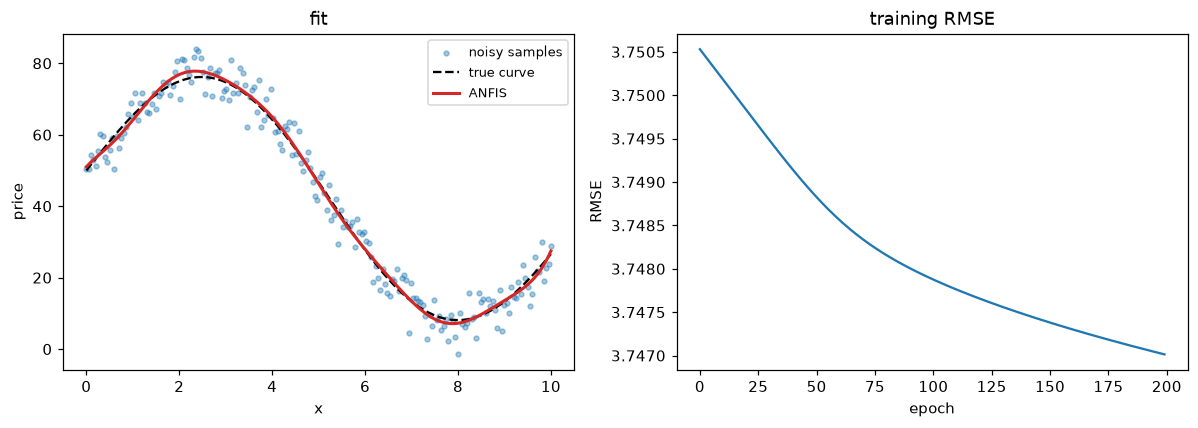
history_ is the RMSE per epoch against the noisy targets, so it bottoms out
near the noise level (≈ 4) — that floor is expected, not a failure to learn:
The real test is how close the prediction is to the true, noise-free curve:
4. Visualize the fit
import matplotlib.pyplot as plt

fig, (ax1, ax2) = plt.subplots(1, 2, figsize=(11, 4))
ax1.scatter(x, noisy, s=10, alpha=0.4, label="noisy samples")
ax1.plot(x, true, "k--", label="true curve")
ax1.plot(x, pred, "C3", lw=2, label="ANFIS")
ax1.legend()
ax2.plot(model.history_)
ax2.set_xlabel("epoch"); ax2.set_ylabel("RMSE")
plt.show()
Notes
- Because the rule count grows as
n_mf ** n_inputs, ANFIS suits low-dimensional problems; keepn_mfmodest as inputs grow. ANFISfollows the scikit-learn estimator protocol, so it drops into aPipelineorGridSearchCV— see Batch, I/O & sklearn.