Interval type-2 (IT2)
A type-1 fuzzy set assigns each point a single membership degree. An interval
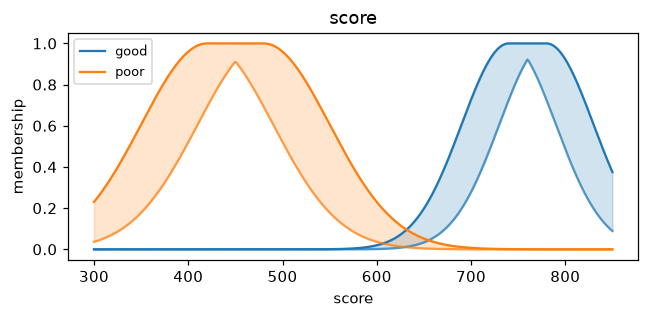
type-2 set assigns an interval [lower, upper]: it is bounded by a lower
membership function (LMF) and an upper membership function (UMF), and the gap
between them is the footprint of uncertainty (FOU). This models uncertainty
about the membership function itself — useful when "good" or "high" has no sharp,
agreed-upon definition.
IT2 rules use the same operator syntax as type-1 rules; only the membership functions and the engine change.
Building IT2 sets
import fuzzytool as fz

# A Gaussian whose mean is uncertain across [630, 680]:
fair = fz.it2_gauss_uncertain_mean(630, 680, sigma=60)

# A Gaussian with uncertain spread:
mid = fz.it2_gauss_uncertain_std(5.0, sigma_lo=0.8, sigma_hi=1.4)

# Height uncertainty: LMF is a scaled-down copy of a type-1 MF:
hi = fz.it2_scale(fz.gauss(8, 1.5), scale=0.6)

# Or supply the lower and upper MFs explicitly:
custom = fz.it2(lower=fz.tri(2, 5, 8), upper=fz.tri(0, 5, 10))
Membership is an interval — fair(650) returns (lower, upper); the engines
also read fair.lower(x) and fair.upper(x).
IT2 inference
IT2Mamdani uses center-of-sets type
reduction; IT2TSK type-reduces crisp
consequents directly. Both return the midpoint of the type-reduced interval
[y_l, y_r].
score   = fz.Variable("score", (300, 850))
score["good"] = fz.it2_gauss_uncertain_mean(740, 780, 50)
score["poor"] = fz.it2_gauss_uncertain_mean(420, 480, 70)
premium = fz.Variable("premium", (0, 12))
premium["low"]  = fz.it2_gauss_uncertain_mean(1.5, 2.5, 1.5)
premium["high"] = fz.it2_gauss_uncertain_mean(9.5, 10.5, 1.5)

sys = fz.IT2Mamdani()
sys.rule(score["good"], premium["low"])
sys.rule(score["poor"], premium["high"])
sys(score=780)    # -> 2.29  (midpoint of the type-reduced interval)
A ready-made example is fuzzytool.datasets.credit_risk_it2.
Batch inference and no-rule policy
The IT2 engines take the same arguments and expose the same behavior as the
type-1 ones — predict, on_no_rule, complement, explain, summary, and
fz.save / fz.load:
sys = fz.IT2Mamdani(on_no_rule="nan", reducer="eiasc")
sys.predict(score=np.array([780.0, 520.0]))
sys.firing_intervals(score=780)      # the [lower, upper] firing of each rule
Type reduction
Type reduction collapses the interval-valued output into a crisp interval
[y_l, y_r]. Three reducers are available, selected by name on either engine:
reducer |
Method | Result |
|---|---|---|
"km" (default) |
Karnik-Mendel | exact |
"eiasc" |
Enhanced Iterative Algorithm with Stop Condition | exact, same interval, faster |
"nie-tan" |
Nie-Tan closed form | approximate, one pass |
EIASC walks the sorted points once and stops at the switch point instead of re-averaging repeatedly. At the rule-base sizes fuzzy systems actually use it is 6-12× faster than Karnik-Mendel and returns the identical interval — verified against KM on random problems in the test suite. Nie-Tan is an order of magnitude faster still, at the cost of being approximate; it suits control loops where the exact switch points do not matter.
fuzzytool implements Karnik-Mendel as a single reusable primitive
(fuzzytool.type2.reduction): km_endpoint finds
one endpoint, karnik_mendel returns both, and centroid_it2 applies it to
compute an IT2 set's centroid interval.
import numpy as np
from fuzzytool.type2.reduction import centroid_it2

good = fz.it2_gauss_uncertain_mean(740, 780, 50)
universe = np.linspace(300, 850, 400)
centroid_it2(good, universe)   # -> (738.05, 772.07), the [y_l, y_r] centroid interval
Visualization
import matplotlib.pyplot as plt
from fuzzytool import viz

viz.plot_it2_variable(score)   # draws each term's LMF/UMF with a shaded FOU
plt.show()
General type-2 (zSlices)
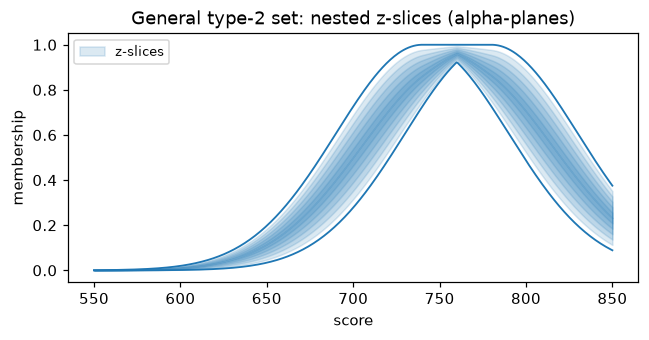
An IT2 set treats every point inside its FOU as equally possible. A general
type-2 set adds a secondary membership that weights those possibilities —
the third dimension IT2 discards. fuzzytool represents a GT2 set with the
zSlices / alpha-plane decomposition: slicing the secondary domain at levels
z turns the GT2 set into a stack of ordinary IT2 sets, so inference and type
reduction reuse the IT2 machinery and combine the slices weighted by z.
Each constructor builds a GT2 set from an IT2 footprint plus a triangular
secondary peaking at the principal (mid) MF — narrow at z = 1, the full FOU
at z → 0:
import fuzzytool as fz

score = fz.Variable("score", (300, 850))
score["good"] = fz.gt2_gauss_uncertain_mean(740, 780, 50, n_slices=5)
score["poor"] = fz.gt2_gauss_uncertain_mean(420, 480, 70, n_slices=5)
premium = fz.Variable("premium", (0, 12))
premium["low"]  = fz.gt2_gauss_uncertain_mean(1.5, 2.5, 1.5)
premium["high"] = fz.gt2_gauss_uncertain_mean(9.5, 10.5, 1.5)

sys = fz.GeneralType2Mamdani()
sys.rule(score["good"], premium["low"])
sys.rule(score["poor"], premium["high"])
sys(score=780)    # -> 2.31  (z-weighted average of per-slice IT2 results)
A GT2 term also exposes lower/upper (its overall FOU), so it can stand in for
its IT2 footprint inside an IT2Mamdani if you want the cheaper approximation.
Build a GT2 set from any IT2 footprint with
gt2_from_it2, and type-reduce a single
GT2 set with centroid_gt2: