Getting started
We build a credit-risk premium system: a lender turns a borrower's credit
score (300–850) and debt-to-income ratio (dti, 0–50%) into a risk
premium (0–12 points) to add on top of its base interest rate.
1. Define linguistic variables
A Variable is a named universe plus named terms
(fuzzy sets). Generate terms automatically, or set them explicitly.
import fuzzytool as fz

# Explicit membership functions:
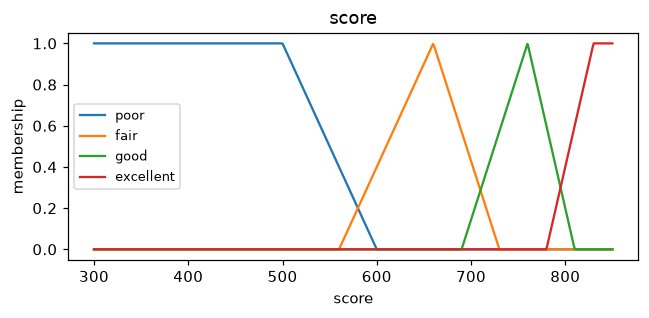
score = fz.Variable("score", (300, 850))
score["poor"] = fz.trap(300, 300, 500, 600)
score["fair"] = fz.tri(560, 660, 730)
score["good"] = fz.tri(690, 760, 810)
score["excellent"] = fz.trap(780, 830, 850, 850)

# Or auto-generated, evenly spaced terms:
dti = fz.Variable("dti", (0, 50), terms=["low", "moderate", "high"])
premium = fz.Variable("premium", (0, 12), terms=["low", "medium", "high"])
2. Write rules with operators
Indexing a variable with a term name gives a proposition you combine with
operators: & (AND, t-norm), | (OR, s-norm), ~ (NOT, complement).
sys = fz.Mamdani(defuzz="centroid")
sys.rule(score["poor"] | dti["high"], premium["high"])
sys.rule(score["fair"] & dti["moderate"], premium["medium"])
sys.rule(score["good"] | score["excellent"], premium["low"])
3. Run inference
The system is callable. Pass crisp inputs by variable name:
sys(score=800, dti=10)    # strong borrower -> 2.45 pts (low premium)
sys(score=520, dti=42)    # weak borrower   -> 9.93 pts (high premium)
4. Visualize (optional)
import matplotlib.pyplot as plt
from fuzzytool import viz

viz.plot_variable(score)
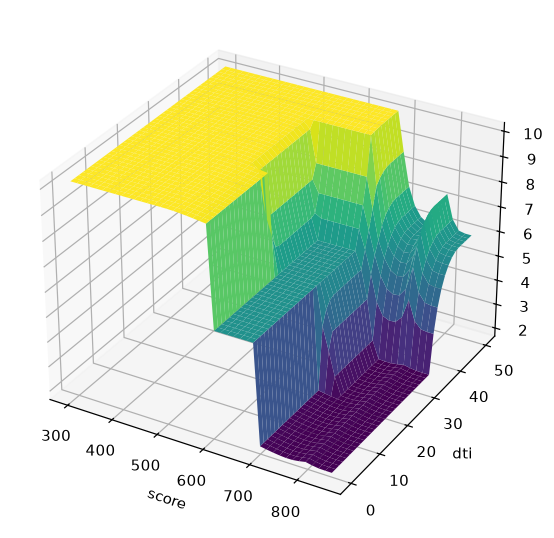
viz.control_surface(sys, score, dti)
plt.show()